











Oxygen Not Included: Build, Survive, Automate & Try Not to Run Out of Air 🚀
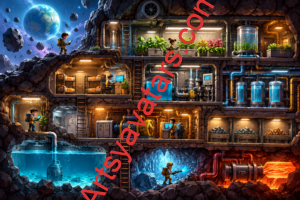 Some survival games throw monsters at you. Others send you into dangerous battlefields. Oxygen Not Included does something completely different: it gives you a tiny underground colony and asks whether you can keep an increasingly complicated network of people, machines, gases, liquids, heat, food, electricity, and resources working together. 😅
That sounds simple at first.
It definitely is not.
Your colony may begin with a few basic rooms and a handful of urgent needs. Before long, you can find yourself thinking about airflow, temperature, plumbing, power consumption, food production, transportation, automation, waste management, and whether one innocent-looking machine is slowly turning half the base into an oven.
That is exactly why Oxygen Not Included can become so addictive. It turns survival into a giant engineering puzzle where every solution can create another problem.
🌌 What Is Oxygen Not Included?
Oxygen Not Included is a space-colony simulation game developed and published by Klei Entertainment. Instead of controlling one heroic character, you manage a growing group of colonists trying to survive inside a hostile underground environment.
Your job is not simply to build walls and furniture. You need to create a functioning habitat.
That means providing breathable air, food, water, sanitation, power, manageable temperatures, useful infrastructure, and eventually more advanced systems that can keep the colony operating efficiently.
The difficulty comes from how closely those systems interact.
A new machine might consume more electricity. More electricity generation might create additional heat. More colonists might increase food and oxygen demand. A larger base can make travel less efficient. Expanding into a new region may provide valuable resources while introducing completely different environmental challenges.
Every improvement has consequences. 🛠️
🫁 Oxygen Is Only the Beginning
The name of the game gives you your first major clue: breathable air matters.
At the beginning, oxygen can feel like the central problem. You need enough of it, and you need to make sure it reaches the places where your colony actually lives and works.
But the deeper you go, the more you realize that oxygen is simply the first layer of the puzzle.
Temperature matters.
Food matters.
Power matters.
Water matters.
Waste matters.
Travel time matters.
Machine placement matters.
Suddenly, your colony is no longer a collection of rooms. It is an interconnected system.
That transformation is one of the best parts of the experience. You begin by solving obvious survival problems and gradually start thinking like an engineer.
⚙️ Every System Connects to Another System
One of the most satisfying things about Oxygen Not Included gameplay is watching several small systems combine into something much larger.
Imagine creating a new power system.
At first, the goal seems obvious: produce electricity.
But electricity powers machines. Machines can create heat. Heat can affect nearby areas. Some areas need carefully controlled temperatures. Resources must be delivered to equipment. Workers need access to the machinery. The entire setup must fit into your colony without creating a traffic nightmare.
One project can therefore turn into five different projects.
And somehow, that feels rewarding instead of annoying. 😂
The game constantly encourages you to think:
“Can I make this system cleaner, safer, faster, or more efficient?”
🔥 Heat Can Become Your Silent Enemy
Many new players naturally focus on obvious survival resources first. Heat can be easier to ignore because it often becomes dangerous gradually.
That makes temperature management especially interesting.
A poorly planned area may work perfectly for a long time before the consequences become noticeable. Machinery produces heat, environmental conditions change, and suddenly a once-stable part of your colony starts creating problems elsewhere.
This creates an important lesson: short-term success does not always mean long-term stability.
Your colony needs room to grow.
It needs systems that can be upgraded.
And it needs you to recognize when an early-game solution has reached its limits.
🏗️ Base Building With Real Consequences
In many building games, room placement is mostly about appearance.
Here, layout can become part of your strategy.
How far do colonists have to travel?
Where should important resources be stored?
Should noisy or heat-producing equipment sit beside living spaces?
Which areas should be close together?
Where should gases and liquids move?
Can the base be expanded without rebuilding everything?
These questions mean that a beautiful colony is not necessarily an efficient colony—and an efficient colony does not always stay efficient as it grows.
That gives players a huge amount of creative freedom.
Two people can face the same survival challenge and build completely different solutions.
🤖 Automation Is Where Things Get Seriously Fun
As your colony becomes more advanced, manually managing every system becomes increasingly difficult.
That is where automation becomes incredibly satisfying.
Instead of constantly reacting to problems yourself, you can create systems that react automatically under certain conditions.
This changes the way you think about the colony.
Early game:
“How do I make this work?”
Later game:
“How do I make this work automatically?”
Eventually:
“How do I make this absurd machine even more efficient?” 😎
For gamers who enjoy optimization, automation can become one of the most rewarding parts of the entire experience.
🧠 Failure Is Part of the Fun
Oxygen Not Included is the kind of game where failure can become a story rather than simply a game-over screen.
Maybe your oxygen production could not keep up with population growth.
Maybe you built too many machines before upgrading your power network.
Maybe your food production looked stable until another system changed.
Maybe a perfectly organized plan collapsed because of one detail you completely overlooked.
Those moments can be frustrating—but they are also memorable.
More importantly, they teach you something.
Your next colony becomes smarter because your previous colony failed.
You remember the mistake.
You recognize the warning signs earlier.
You start planning ahead.
In that sense, knowledge becomes one of your most important upgrades.
🔬 Exploration Keeps the Experience Fresh
Your starting area is only the beginning.
Exploring deeper into the environment can reveal additional materials, creatures, environmental conditions, and opportunities for new systems.
That exploration is especially interesting because discovery and engineering are connected.
Finding something valuable does not automatically mean you can use it.
You may need new infrastructure.
You may need better temperature management.
You may need new transportation routes.
You may even need to redesign part of the colony before the discovery becomes genuinely useful.
This makes exploration feel meaningful because it can change how you build.
👷 Your Colonists Are More Than Moving Resources
A successful colony is not only about machines.
Your colonists need an environment where they can work, rest, eat, and perform important jobs without everything descending into chaos.
That human element gives colony management more personality.
Instead of designing an empty factory, you are building a place where your workers actually live.
Efficiency still matters—but so does making sure the people keeping your complicated machine alive can continue doing their jobs.
That balance between infrastructure and colony management helps prevent the game from becoming a purely mechanical puzzle.
💧 Plumbing Becomes Surprisingly Entertaining
Few games can make you stare proudly at a network of pipes.
Oxygen Not Included can. 😂
Moving liquids and gases where they need to go can become a puzzle of its own. Once your base becomes larger, clean routing and sensible infrastructure can save a huge amount of trouble.
There is something deeply satisfying about looking at a previously chaotic system and transforming it into an organized network that finally behaves the way you intended.
Until you expand again, of course.
⚡ The Best Solutions Often Create New Problems
This may be the game’s greatest trick.
You solve one problem.
Then that solution creates another.
You solve that problem.
Now the colony consumes more resources.
You expand production.
Expansion creates more heat.
You solve the heat issue.
Now your power demand increases.
And suddenly it is 2:00 a.m. and you are redesigning an underground utility network because one machine is ruining everything. 😅
This constant chain reaction gives the game tremendous momentum.
🎮 Who Will Enjoy Oxygen Not Included?
This game is especially well suited to players who enjoy:
- 🏗️ Base-building games
- 🧠 Complex strategy and problem solving
- ⚙️ Automation and optimization
- 🌡️ Resource and temperature management
- 🚀 Space and science-fiction settings
- 📊 Management simulations
- 🔬 Experimenting with interconnected systems
- 😂 Games where your own mistakes create memorable stories
If your favorite gaming question is “How can I make this more efficient?”, there is a very good chance you will find something to love here.
💡 Beginner Tips Without Spoiling the Fun
1. Solve the Immediate Problem First
Your first solution does not have to be permanent. Build something that works, understand its limits, and improve it later.
2. Leave Space for Expansion
A system that looks enormous early in the game may feel tiny once your colony grows.
3. Watch Temperature
Heat problems can develop gradually. Paying attention early can prevent painful redesigns later.
4. Avoid Expanding Too Fast
More colonists also mean greater demand for essential resources. Growth is useful only when your infrastructure can support it.
5. Learn From Disaster
A failed colony is not wasted time. It is information for the next one.
🌊 More Worlds and Systems Beyond the Base Experience
The game has also expanded through additional official content, giving experienced players more environments and systems to explore.
For a game built around experimentation, that broader range of environments fits naturally with the core appeal: learn the rules, build a system, discover its weaknesses, then improve it.
😂 Why Watching Everything Go Wrong Is Weirdly Enjoyable
There is a special kind of humor in colony simulators.
You spend an hour creating an elegant system.
You admire it.
You believe you have finally achieved engineering perfection.
Then one tiny overlooked issue creates a chain reaction.
Your efficient base becomes an emergency-management simulator.
And somehow you are laughing while trying desperately to save it.
Those unscripted moments are what make colony games memorable. The stories belong to your playthrough rather than a predetermined cinematic sequence.
🏆 Final Verdict: Is Oxygen Not Included Worth Playing?
Oxygen Not Included stands out because it makes complicated systems entertaining.
It can make oxygen precious.
It can make plumbing satisfying.
It can make temperature terrifying.
It can make a perfectly routed power network feel like an achievement worthy of celebration. 🎉
The deeper you go, the more the game rewards curiosity, experimentation, patience, and creative problem solving.
You do not need to understand everything immediately.
In fact, discovering how everything works is part of the fun.
If you enjoy colony simulators, management games, automation, survival systems, and the glorious chaos that appears when several complicated systems collide, Oxygen Not Included is an experience worth exploring. 🚀
Now it is your turn: What was the funniest or most disastrous mistake you ever made in a colony-building game? Share your story with the ArtsyAvatars community! 🎮👇
Independent editorial notice: This article is original commentary for ArtsyAvatars.com. “Oxygen Not Included” is referenced solely to identify and discuss the game. ArtsyAvatars is not claiming ownership of the game, its characters, logos, artwork, screenshots, or other protected assets, and is not presented as affiliated with or endorsed by Klei Entertainment.