











❄️ Frostpunk: Why This Frozen Survival City-Builder Still Grips Gamers
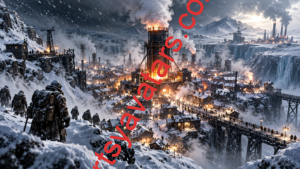 Some strategy games ask you to build the biggest city. Others ask you to become the richest ruler. Frostpunk asks a much harsher question: how far are you willing to go to keep a society alive when warmth, food, hope, and time are all running out?
Released in 2018 by 11 bit studios, Frostpunk combines city-building, survival management, and difficult social decisions inside a frozen post-apocalyptic setting. Instead of simply expanding a settlement, players must constantly balance resources, temperature, working conditions, public hope, and dissatisfaction while facing increasingly severe threats.
That mixture is what makes the Frostpunk survival city-builder experience so memorable. You are not just arranging buildings. You are managing people whose survival depends on almost every decision you make. 🌨️
🔥 The Real Enemy Is the Cold
In many city-building games, weather is something happening in the background. In Frostpunk, extreme cold affects nearly everything.
Homes need warmth. Workplaces need warmth. Medical facilities need warmth. As temperatures fall, keeping essential areas heated becomes more difficult, forcing you to rethink where people work, where they live, and how limited fuel should be distributed.
This creates a powerful chain reaction. A shortage of one resource can make another problem worse. Reduced production may weaken your fuel supply. Poor heating can contribute to illness. Too many sick citizens can reduce the number of available workers. Suddenly, what looked like a small management mistake becomes a city-wide emergency.
That constant pressure gives Frostpunk its distinctive rhythm: build, prepare, adapt, survive, and then prepare again. ❄️🔥
⚙️ Resource Management That Makes Every Decision Matter
Resource management sits at the heart of Frostpunk. Players must collect and allocate materials while planning ahead for future emergencies.
Coal or other heat-related resources keep vital systems operating. Wood and steel support construction and technological development. Food production keeps the population functioning. Workers and engineers must also be assigned carefully because people themselves are a limited resource.
The challenge is not simply gathering more of everything. The real challenge is deciding what deserves priority.
Do you build more shelter now or invest in infrastructure that may help later? Do you place more workers on fuel production or increase food output? Do you expand quickly or conserve resources for an approaching crisis?
There is rarely one universally perfect answer. That uncertainty is one reason strategy fans can spend hours experimenting with different approaches. 🧠
⚖️ Laws Turn City Management Into Moral Strategy
One of Frostpunk’s most interesting ideas is that survival is not only an engineering problem. It is also a social problem.
Players can introduce laws that influence working conditions, healthcare, food distribution, public order, and other parts of society. These decisions can provide practical advantages, but they may also create moral discomfort or long-term consequences.
A decision that looks efficient on a statistics screen may feel much more complicated when you think about the people affected by it.
This gives Frostpunk something many strategy games struggle to create: emotional weight. The question is not only, “Will this strategy work?” It becomes, “What kind of society am I creating in order to survive?”
😨 Hope and Discontent Are Resources Too
Wood, steel, food, and heat are visible resources, but Frostpunk also makes public morale part of the survival equation.
Citizens react to difficult conditions and leadership decisions. Promises, shortages, long working hours, dangerous environments, and social policies can influence how people respond to your leadership.
This means the city cannot be treated like a machine made only of numbers. Keeping production efficient while ignoring human consequences can create serious problems.
The result is an unusual type of strategy experience where emotional pressure becomes part of the gameplay. You may know exactly what would improve production, yet still hesitate because of what that choice could mean for the population.
🏭 A City Designed Around Survival
Frostpunk’s city-building structure reinforces its survival theme. Instead of giving players a huge peaceful landscape, the game encourages tightly planned development around essential infrastructure and heating coverage.
Space matters. Building placement matters. Travel distance matters. Heating efficiency matters.
As the settlement grows, your early decisions can influence later expansion. A poorly planned layout may create inefficiencies just when the weather becomes more dangerous. A well-organized city can give you valuable breathing room during emergencies.
This makes planning satisfying because visual city growth is directly connected to survival rather than decoration alone.
🔬 Technology Can Save You — If You Invest in Time
Research introduces another important strategic layer. New technologies can improve gathering, heating, healthcare, exploration, and general efficiency.
But research itself requires resources and skilled workers. Investing heavily in technology can weaken immediate production, while ignoring research can leave the city poorly prepared for future conditions.
That creates one of Frostpunk’s recurring strategic dilemmas: should you solve today’s emergency or prepare for tomorrow’s disaster?
Experienced players often learn that surviving the next few minutes is not enough. Good planning means anticipating what the city will need before the crisis arrives.
🧭 Exploration Expands the World Beyond Your City
Your settlement may be the center of the experience, but the frozen world beyond it also matters.
Exploration can reveal resources, survivors, information, and opportunities that may influence the future of the city. Sending people away from the safety of the settlement can be risky, but staying isolated may also mean missing valuable discoveries.
This adds another layer of decision-making because your attention is divided between problems inside the city and possibilities outside it.
🎮 Why Frostpunk Appeals to Strategy Gamers
The strongest part of Frostpunk is how closely its systems connect. Heating affects health. Health affects labor. Labor affects production. Production affects construction and food. Laws influence social stability. Exploration may provide resources or people that change your plans completely.
Because these systems interact, the game rarely feels like a simple checklist of tasks.
Instead, players constantly respond to new situations. A plan that worked during one stage of the game may become ineffective when temperatures fall or population needs change.
That makes the experience especially appealing to gamers who enjoy:
- 🧠 Strategic planning under pressure
- 🏗️ City-building with meaningful limitations
- 📦 Resource management
- ⚖️ Difficult choices with consequences
- 🌨️ Atmospheric survival settings
- 🔁 Experimenting with different approaches
🚫 Common Mistakes New Players Make
New players often focus too heavily on solving the most visible problem while ignoring the systems connected to it.
For example, increasing production is useful, but not if workers become too sick to keep producing. Building more homes helps population needs, but poorly heated housing can create another crisis. Expanding rapidly may look impressive, but spending resources too quickly can leave you unprepared for colder weather.
A better approach is to think in chains rather than isolated decisions. Before committing resources, ask what that choice will affect next.
Frostpunk rewards preparation far more than panic.
💡 Beginner-Friendly Survival Tips
Plan before expanding. Every building consumes resources and space, so growth should solve a real problem.
Watch temperature changes. Preparing before colder weather arrives is much easier than reacting after the population is already suffering.
Protect your workforce. Production collapses quickly when too many people are unavailable.
Invest in research. Better technology can turn an unstable settlement into a far more efficient one.
Do not ignore morale. A technically efficient city can still become unstable when citizens lose confidence.
Expect mistakes. Frostpunk is built around difficult trade-offs. Learning why a city failed can make the next attempt much stronger.
🌨️ More Than a Traditional City Builder
Frostpunk works because survival, city management, and social choices are never completely separated.
You build because people need protection. You research because conditions are becoming worse. You create laws because ordinary systems are no longer enough. You explore because the city cannot always survive with what it already has.
Every layer pushes the player back toward the same central problem: keeping a fragile society alive in an environment that constantly threatens to destroy it.
🏁 Final Thoughts
Frostpunk remains an excellent choice for gamers who enjoy city-building but want something more stressful, personal, and decision-driven than a traditional construction simulator.
Its greatest strength is not simply the frozen setting. It is the way the game turns heat, resources, laws, technology, and public morale into interconnected survival problems.
When everything is working, you feel like a brilliant planner. When one system begins to collapse, the entire city can suddenly feel one storm away from disaster.
And that is exactly what makes surviving so satisfying. ❄️🔥
What would you prioritize first in a frozen city: heat, food, shelter, or technology? Share your strategy with the ArtsyAvatars gaming community! 🎮
Editorial note: This independent article discusses Frostpunk for commentary and informational purposes. Frostpunk and related intellectual property belong to their respective rights holders. ArtsyAvatars is not affiliated with or endorsed by the game’s developer or publisher.