











Captain of Industry: Build, Mine, Automate, and Master Your Island Empire 🏭⛏️
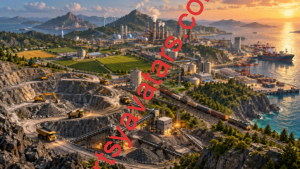 What if your next strategy game started not with a mighty empire, but with a remote island, limited resources, a small population, and one enormous challenge: build a functioning industrial civilization from the ground up?
Captain of Industry is a factory-building and management game built around mining, production chains, logistics, agriculture, research, settlement management, and large-scale industrial expansion. The game entered Early Access on May 31, 2022, and remains under active development in 2026. Its official listing describes progression from basic resource processing all the way toward nuclear power and space technology.
For gamers who enjoy watching a tiny operation evolve into a sprawling, interconnected machine, this is the kind of simulation where one small production problem can eventually become a huge engineering puzzle. ⚙️
🏝️ What Is the Captain of Industry Game About?
You begin on an island and gradually transform it into a productive industrial settlement. Raw materials must be extracted, processed, transported, stored, and converted into increasingly sophisticated products. At the same time, your population needs essentials such as food, water, electricity, housing, and healthcare.
The result is more than a simple “place a factory and watch it run” experience. Your mines feed processors. Processors feed manufacturing lines. Trucks, conveyors, pipes, ships, and trains connect different parts of the economy. Farms support the population, research unlocks new possibilities, and waste or pollution can create additional problems if the industrial system is poorly planned.
That interconnected design is what gives the game its identity. A shortage of one basic material can ripple through several production chains, forcing you to rethink your layout rather than simply build more machines.
⛏️ Mining Is More Than Clicking on a Resource
One of the most interesting features is its dynamic terrain. Mining can physically alter the island, while excavation and dumping allow players to reshape land, create slopes, flatten areas, fill terrain, and even reclaim parts of the shoreline.
This means geography becomes part of the strategy. A mountain is not simply scenery. It can contain valuable resources, block vehicle routes, or become a major engineering project. Likewise, unwanted rock is not merely a number in storage—it can become material for changing the landscape.
For players who enjoy seeing their decisions leave visible marks on a game world, this creates a satisfying sense of industrial transformation. 🚜
🏭 Build Production Chains That Actually Feel Connected
The heart of Captain of Industry is factory design. Early production begins with relatively basic processes such as metal smelting, construction materials, and food processing. Research gradually opens more advanced industrial systems, including oil processing, electronics, computing, and late-game technologies connected with energy and space development.
The challenge is rarely just “Can I build this machine?” The better question is: Can I feed it continuously, move its output efficiently, provide enough power, manage by-products, and expand the system without creating a logistical disaster?
That makes optimization deeply rewarding. Improving one bottleneck can suddenly revive several downstream factories. A clean conveyor layout can reduce vehicle traffic. A better rail connection can change how an entire mining region operates. Every improvement becomes part of a larger machine.
🚚 Logistics Fans Have Plenty to Manage
Transportation is a major part of the game. Trucks can handle general deliveries, while conveyors and pipes provide direct high-throughput connections. Rail systems allow bulk materials to move over longer distances, and newer development updates have expanded the transport toolbox with additional train features, bridges, and amphibious vehicles.
This gives players several possible approaches. You can rely heavily on vehicles during early expansion, then gradually automate major routes as production volumes grow. Or you can deliberately build organized industrial districts connected by dedicated transport infrastructure.
There is something extremely satisfying about zooming out and watching ore leave a mine, travel across the island, enter a processing complex, and emerge several stages later as a high-value product. 🚂
🌾 Your Industry Still Needs People
An industrial empire cannot function without its population. Farms produce crops, food can be processed, and advanced agricultural systems can increase production. Residents also need supporting infrastructure and public services.
This creates an important tension: expanding industry consumes resources, power, space, and labor, but expanding too aggressively can put pressure on the very settlement that supports your factories.
Good players therefore have to think like both engineers and planners. Production efficiency matters, but so does maintaining the systems that keep the population functioning.
🧠 Research Keeps the Island Evolving
The official game description currently advertises more than 100 technologies. Research gradually pushes the island from relatively basic industry toward advanced manufacturing, major energy systems, and ultimately space-related development.
This long technological arc gives each phase a different feel. Early problems are often about basic materials and survival. Later problems become increasingly focused on throughput, energy, transportation, resource efficiency, and complex multi-stage production networks.
That constant escalation is one of the main reasons factory-building games can become so absorbing: solving today’s bottleneck often creates tomorrow’s bigger challenge.
🌍 Explore, Trade, and Work Toward Self-Sufficiency
The island is not completely isolated. Players can explore a wider world map, interact with settlements, trade for resources, and establish recurring exchanges. The game’s longer-term progression also includes ambitions beyond the island itself, including rockets, a space station, and asteroid-related resource development.
Trade can be especially useful when local production cannot immediately satisfy demand. But relying permanently on outside resources can create another strategic question: should you keep importing, or redesign the economy to become more independent?
🎮 Who Will Enjoy Captain of Industry Most?
This game is especially appealing if you enjoy:
- ⚙️ Designing complex production chains
- ⛏️ Mining and resource extraction
- 🏗️ Building large industrial layouts
- 🚛 Managing trucks, conveyors, pipes, ships, and trains
- 🌾 Balancing industry with settlement needs
- 📊 Solving bottlenecks and efficiency problems
- 🧠 Long research and technology progression
- 🗺️ Reshaping terrain to support expansion
- 🚀 Working toward ambitious late-game goals
If you prefer constant action, fast combat, or heavily story-driven gameplay, this style of simulation may feel deliberately slow. But if your idea of fun is spending twenty minutes redesigning a transport route—and feeling strangely proud when everything finally flows perfectly—Captain of Industry deserves a look. 😄
🔥 What Makes the Experience So Addictive?
The strongest part of this type of game is the feedback loop. You identify a problem, design a solution, watch the system begin working, and then discover a new problem created by your success.
Need more steel? Expand mining. More mining needs more trucks. More trucks need fuel. More processing needs electricity. More workers need food and services. Suddenly, a simple steel shortage has become an island-wide infrastructure project.
That is where Captain of Industry shines as a management sandbox: the fun comes from building systems that interact with other systems.
🛠️ Early Access Means the Game Is Still Evolving
As of October 2026, Captain of Industry remains an Early Access title. The developers state that additional systems, content, user-experience work, graphics improvements, performance work, and progression development are still planned before a full 1.0 release. They also caution that major updates can sometimes require players to adjust existing factories or, in some cases, begin a new save.
That is worth knowing before jumping in. You are playing a substantial simulation, but also one that is still changing.
🏁 Final Thoughts
Captain of Industry turns an empty island into a giant engineering problem—and that is exactly the appeal.
Mining changes the terrain. Factories consume and create interdependent resources. Vehicles and transport networks keep everything moving. Farms and public infrastructure support the population. Research continuously expands what your civilization can build. Eventually, a once-modest settlement can become an industrial network stretching from deep mines to advanced energy and space technology. 🌌
If you love factory automation, logistics, resource management, and strategy games where efficiency matters, this is a title worth exploring.
What would you build first: a perfectly optimized factory district, a massive mining operation, or an island-wide train network? 🎮 Let us know and explore more gaming features, guides, and creative content at ArtsyAvatars.com.
Editorial/IP note: This article is independent commentary created for ArtsyAvatars.com. “Captain of Industry” is used only to identify the game being discussed. No official artwork, screenshots, logos, game code, or other proprietary visual assets are reproduced in this article.