


Titanfall: When Speed, Parkour and Giant Machines Collide 🤖⚡
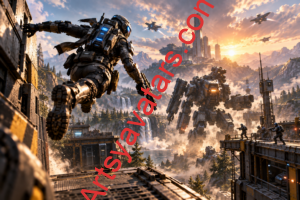 Some shooters keep your boots firmly planted on the ground. Titanfall had a very different idea. 🚀
Developed by Respawn Entertainment and originally released in 2014, Titanfall built its identity around fast first-person multiplayer combat where agile Pilots could race across the battlefield before calling in enormous armored Titans. The result was a shooter where movement, verticality and changing combat scale were just as important as pulling the trigger.
If you enjoy futuristic shooters, giant machines and movement systems that encourage you to keep moving, here’s what made the original Titanfall such an interesting chapter in multiplayer gaming. 🎮
🤖 Two Very Different Ways to Fight
The central idea behind Titanfall is wonderfully simple: battles aren’t limited to soldiers fighting other soldiers.
As a Pilot, mobility is one of your greatest weapons. Players can move rapidly around environments, use parkour-style wall running and double jumps, and attack from places that would be difficult to reach in a conventional military shooter.
Then the scale changes. 💥
Players can enter heavily armored Titans and suddenly experience the battlefield from the perspective of a towering war machine.
That Pilot-versus-Titan contrast gives encounters a distinctive rhythm. One moment can be about speed and evasion; the next can become a confrontation between massive machines.
⚡ Movement Makes the Battlefield Feel Different
One of Titanfall’s defining features is its emphasis on mobility.
Instead of treating walls and vertical structures purely as obstacles, the movement system encourages players to use the environment. Wall running and large jumps can open new approaches through an area and make combat feel more three-dimensional.
🏃 Run.
🧱 Hit the wall.
🚀 Launch toward another platform.
🎯 Find a new angle.
Keeping momentum can become part of the strategy rather than simply a way to travel between firefights.
🔥 From Agile Pilot to Armored Titan
The transition between Pilot and Titan gameplay creates one of the game’s most memorable contrasts.
Pilots emphasize agility and mobility, while Titans bring armor, size and heavy firepower. Because players can move between these styles during a match, tactics can change quickly.
A huge machine doesn’t automatically make the smaller fighter irrelevant, either. The difference in scale creates its own tactical decisions about when to engage, escape, reposition or use the environment.
🌌 A Futuristic Frontier Built for Multiplayer
Titanfall takes place against a distant science-fiction frontier shaped by conflict, technology and industrial environments.
The original game was designed as a multiplayer-focused experience, combining competitive matches with cinematic elements normally associated with campaign sequences.
That approach helped matches feel like parts of a much larger conflict rather than isolated arenas.
🎯 Why Titanfall Stood Out
Titanfall entered a crowded first-person shooter genre, but several ideas helped distinguish it:
- ⚡ Fast and fluid Pilot movement
- 🧱 Parkour-style wall running
- 🚀 Large jumps and vertical traversal
- 🤖 Pilot and Titan combat in the same battle
- 🌌 Futuristic science-fiction environments
- 👥 Multiplayer-focused action
- 🎬 Cinematic elements incorporated into online matches
Rather than making its giant machines a background spectacle, Titanfall put them directly into the player’s hands.
🎮 The Joy of Mastering Movement
There is another side to Titanfall beyond its giant machines: learning how to move efficiently.
A beginner might travel through a battlefield using straightforward routes. As players become more comfortable with the movement system, however, walls, rooftops and elevated structures can become potential pathways.
That creates a satisfying sense of improvement. You’re not only learning how to aim better—you are learning how to navigate the battlefield differently. ⚡
🤖 A Fascinating Piece of Shooter History
The original Titanfall is now unavailable for purchase through EA, but its combination of rapid Pilot mobility and massive Titan combat remains an interesting example of experimentation within multiplayer FPS design.
Its sequel, Titanfall 2, expanded the concept further and introduced the franchise’s first dedicated single-player campaign alongside expanded multiplayer gameplay.
🎨 Sci-Fi Gaming Inspiration for ArtsyAvatars
Love futuristic gaming aesthetics?
At ArtsyAvatars.com, explore creative avatar inspiration built around gaming culture, science-fiction aesthetics and imaginative digital identities.
Think armored explorers, futuristic warriors, mechanical worlds and completely original characters that capture the feeling of your favorite genres without simply copying an existing game character.
✨ Your gaming profile doesn’t have to look like everyone else’s.
🏁 Final Thoughts
Titanfall showed how dramatically a first-person shooter can change when movement and scale become central parts of combat.
Wall-running Pilots make the battlefield fast and vertical. Towering machines make it feel enormous. Put those ideas together, and you get a distinctive style of multiplayer action. 🤖⚡
For gamers interested in the evolution of futuristic shooters, Titanfall remains a fascinating game to look back on.
What do you prefer: racing across the battlefield as an agile Pilot or stepping inside a giant machine? 🎮
Editorial/IP Notice: Titanfall is referenced for commentary and informational purposes. ArtsyAvatars.com is not affiliated with, endorsed by, or sponsored by Electronic Arts or Respawn Entertainment. All third-party names and trademarks belong to their respective owners.