










What Remains of Edith Finch: Why This Unforgettable Story Adventure Still Deserves Your Attention 🎮🏚️
 Some games challenge your reflexes. Others test your strategy. What Remains of Edith Finch takes a very different route: it invites you into a family history filled with memories, mystery, imagination, grief, and wonder. 🎭
Developed by Giant Sparrow and published by Annapurna Interactive, the game originally released on April 24, 2017. Its official description presents it as a collection of unusual stories about a family in Washington state, explored from a first-person perspective.
If you enjoy games where atmosphere and storytelling matter more than combat or competitive rankings, this is the kind of experience that can stay in your mind long after the credits roll.
🏚️ What Is What Remains of Edith Finch About?
You play as Edith, a young woman returning to the enormous home connected to her family’s past. As she explores the house, she discovers stories about different members of the Finch family and gradually pieces together the history surrounding them. The official game description explains that each discovered story allows the player to experience part of another family member’s life, with every tale ultimately connected to that person’s death.
That may sound bleak, but the experience is not simply about sadness. The game frequently mixes melancholy with curiosity, fantasy, warmth, humor, unease, and moments of genuine beauty. Instead of treating the house as a conventional level filled with enemies, it turns rooms, objects, passages, and memories into pieces of a larger narrative puzzle.
📖 Storytelling Is the Main Attraction
The biggest reason to experience What Remains of Edith Finch is its approach to interactive storytelling.
Rather than giving every family story the same structure, the game regularly changes the way the player interacts with the world. Giant Sparrow describes the experience as a collection of playable short stories, while the official description notes that the gameplay and tone vary from one family story to another.
That variety helps the adventure feel less like reading a sequence of diary entries and more like stepping inside memories. 🎨 Each segment can communicate personality through interaction, perspective, pacing, and environmental details rather than relying only on lengthy exposition.
🎮 Simple Controls, Creative Experiences
This is primarily a first-person exploration experience rather than an action-heavy game. The official materials consistently describe its stories as being played from a first-person perspective.
For players who normally spend their time with shooters, RPGs, racing games, or competitive multiplayer titles, the slower pace may feel unusual at first. But that simplicity serves an important purpose: it keeps your attention on the environment and the stories being told.
You are encouraged to notice small details, examine spaces carefully, follow unusual routes through the house, and allow each sequence to unfold at its own pace. 🔍
🌲 An Atmosphere Built Around Curiosity
The game is set around the Finch family and their home in Washington state. That setting helps create a strong sense of isolation and discovery.
The house feels less like a normal residence and more like a physical archive of generations. Rooms preserve personalities. Closed spaces create questions. Strange additions and hidden pathways encourage you to wonder what happened before you arrived.
This is one of those games where simply moving through a space can feel meaningful. You are not exploring because a minimap tells you where the next objective is; you explore because the environment itself makes you curious.
💭 A Game About Memory, Family, and Mortality
Death is an unavoidable part of the game’s premise. The official description explicitly states that each family story ends with the death of that family member.
Yet the game is equally interested in how people remember those lives.
Different family members become more than names on a family tree because the player temporarily experiences the world through their perspectives. That approach can make even brief stories feel personal.
It also raises interesting questions without forcing a single interpretation:
- 🧠 How reliable are family stories?
- 📚 How does storytelling shape the way we remember people?
- 🏠 Can a place preserve a family’s identity?
- 🌌 Why can frightening or tragic memories also contain beauty?
Those questions are part of why the game continues to be discussed years after its release.
✨ What Makes What Remains of Edith Finch Different?
1. Every Story Has Its Own Personality
The game changes tone and interaction style from story to story rather than repeating one formula. That variety is confirmed in the official game description.
2. The Environment Tells Part of the Story
Rooms, objects, architecture, and personal spaces provide context without requiring constant dialogue. Players who enjoy environmental storytelling have plenty to observe.
3. It Respects the Player’s Attention
Instead of filling the experience with unrelated side activities, the game remains tightly focused on the Finch family and Edith’s exploration.
4. It Can Appeal Beyond Traditional Adventure Fans
You do not need fast reactions or deep knowledge of complex game systems to understand the central experience. The emphasis is on exploration, observation, and participation in the stories.
⚠️ Is It a Horror Game?
It contains dark themes, unsettling situations, and repeated references to death, but describing it simply as a conventional horror game would be misleading. PlayStation categorizes it under adventure and horror-related genres, while Steam users commonly tag it with terms including story rich, atmospheric, mystery, exploration, adventure, and psychological horror.
Expect emotional unease and strange imagery rather than a game built primarily around fighting monsters or surviving constant attacks.
🕹️ Who Should Consider Playing It?
What Remains of Edith Finch is especially worth considering if you enjoy:
- 📖 Strong narrative experiences
- 🔍 Environmental storytelling
- 🎭 Emotional and unusual character stories
- 🏚️ Exploring mysterious locations
- 🎨 Games that experiment with interaction
- 🌙 Atmospheric single-player adventures
Players looking mainly for combat systems, character builds, loot progression, or competitive multiplayer will find a very different experience here.
🏆 Why Gamers Still Talk About It
The game received significant industry recognition, including Best Game at the 2018 BAFTA Games Awards and narrative awards cited on its Steam storefront.
Awards alone do not determine whether a game will connect with you, but they help explain why the title became an important reference point in conversations about interactive storytelling.
Its strongest quality is not scale. It is focus. The game takes one family, one extraordinary home, and a sequence of memories, then uses interaction to make those memories feel more immediate than a conventional cutscene might.
🎯 Final Thoughts
What Remains of Edith Finch shows how powerful a game can be when mechanics, environment, and narrative all serve the same emotional purpose.
It does not need enormous battles or hundreds of quests to make an impression. Instead, it asks you to enter a strange family home, pay attention to the lives preserved inside it, and think about how stories survive the people who created them. 🕯️
If you appreciate games that experiment with storytelling and leave room for reflection, this is an adventure worth discovering.
What kind of game stays with you longer: an epic action adventure or a smaller story that hits emotionally? Tell us in the comments on ArtsyAvatars.com! 🎮✨
🖼️ IP-Safer Featured Image Direction
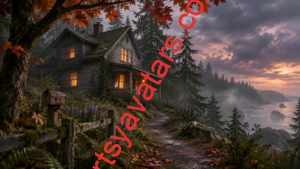
Use an entirely original cinematic scene: a mysterious old coastal house surrounded by evergreen forest and light fog at dusk, viewed from a winding footpath, with warm light glowing from a few generic windows, scattered autumn leaves, dramatic clouds, and a reflective, melancholic mood. Do not reproduce the Finch house, any character, costume, room, prop, artwork, logo, title treatment, screenshot, UI element, or other recognizable game asset. No text or watermark.
Editorial note: “What Remains of Edith Finch” and associated names belong to their respective rights holders. This independent article uses the title only to identify and discuss the game and is not presented as official artwork or affiliation.