









Heaven’s Vault: Decipher a Forgotten Civilization Among the Stars 🌌
 Some games ask you to defeat armies. Others ask you to survive monsters. Heaven’s Vault asks something much stranger: What if the biggest obstacle between you and the truth was a language nobody completely understands?
Developed and published by inkle, Heaven’s Vault is a narrative adventure built around archaeology, exploration, conversation, and the gradual reconstruction of a lost language. The game originally launched for Windows and PlayStation 4 in April 2019 and later arrived on Nintendo Switch in January 2021.
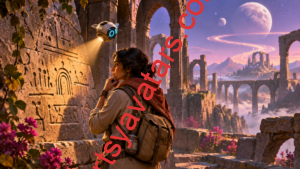
Instead of treating history as background decoration, the game turns history itself into the mystery. Ancient inscriptions, forgotten ruins, broken artifacts, conflicting stories, and uncertain translations all become pieces of a much larger puzzle.
For players who enjoy thoughtful exploration more than constant combat, that makes Heaven’s Vault a fascinating journey. 🧭
🏺 Archaeology Becomes the Main Adventure
You play as archaeologist Aliya Elasra, accompanied by a robot named Six, while investigating a region known as the Nebula. The search begins with a missing roboticist, but the investigation gradually opens into questions about the history of the entire setting.
The unusual part is that discovery does not simply mean collecting objects.
An artifact may contain clues about where it came from. An inscription may suggest a new interpretation of an earlier translation. A conversation might change how you understand a person, location, or historical event.
That creates a rewarding loop:
Explore → discover → interpret → reconsider → explore again.
The process feels closer to solving a historical mystery than following a conventional quest marker.
🔤 The Ancient Language Is a Real Puzzle System
One of Heaven’s Vault’s defining ideas is its fictional hieroglyphic language.
As you discover inscriptions, you try to determine the meaning of unfamiliar symbols. The game does not immediately tell you whether every interpretation is correct. Instead, later discoveries may strengthen or weaken your earlier conclusions. inkle describes the translation system as one in which your chosen meanings affect Aliya’s understanding of what she has found.
That uncertainty makes translation more interesting than a standard “pick the correct answer” puzzle.
You begin noticing repeated shapes. Compare symbols across different inscriptions. You remember earlier guesses. Then a new archaeological discovery can suddenly make an old phrase understandable.
That moment of recognition is one of the game’s strongest pleasures. 🧩
🌌 Exploring the Nebula
The setting is a network of moons connected by unusual “rivers” through space. Rather than remaining in one continuous location, you travel between settlements, archaeological sites, ruins, and other destinations while following historical clues.
The result is a world that feels scattered but connected.
Each location adds another fragment to a history that has been partially forgotten. Some fragments support each other. Others create contradictions. The player is rarely given a perfectly clean historical record.
That is exactly why exploration works so well here.
You are not merely searching for the next collectible. You are trying to understand what happened.
🧠 Your Choices Become Part of the Investigation
Heaven’s Vault uses inkle’s narrative technology to track what you discover, what you say, where you travel, and how you interact with other characters. The official description emphasizes that the story is nonlinear and that characters remember how you treat them.
This does not mean every choice produces an obvious dramatic branch immediately.
Often, the effect is quieter.
A character may trust you differently. A conversation may take another direction. Your interpretation of an artifact may affect the conclusions Aliya reaches. A discovery made early can influence how later information feels.
Because of that, playing Heaven’s Vault can feel less like completing a fixed sequence and more like assembling your own version of an archaeological investigation.
🎨 A Distinctive Presentation
The game combines three-dimensional environments with hand-drawn two-dimensional character artwork, an approach specifically highlighted in inkle’s official materials.
The contrast fits the game surprisingly well.
Ancient ruins and environments provide a sense of place, while the illustrated characters give conversations a storybook quality. The visual presentation reinforces the feeling that you are moving through an old chronicle that is slowly becoming readable.
It is not trying to look like a conventional blockbuster science-fiction game.
Its identity comes from atmosphere, mystery, history, and interpretation.
🎮 Who Will Enjoy Heaven’s Vault?
Heaven’s Vault is especially well suited to players who enjoy:
- narrative-heavy adventures 📖
- archaeological mysteries 🏺
- language and deduction puzzles 🔤
- exploration without constant combat 🧭
- science-fiction settings 🌠
- nonlinear storytelling 🔀
- games where conversations matter 💬
- slowly uncovering hidden lore 🔎
Players looking primarily for fast combat, competitive multiplayer, or constant action may find its pace deliberately slow.
But for someone who enjoys thinking about why a ruined place exists, who created an artifact, or what an unfamiliar inscription might mean, that slower pace becomes part of the attraction.
🕵️ Why the Translation Mechanic Matters
Many games use fictional languages as decoration.
Heaven’s Vault makes language part of the player’s reasoning process.
That difference matters because translation changes the relationship between the player and the fictional world. You are not simply receiving lore through dialogue boxes. You are actively attempting to reconstruct it.
Every inscription becomes evidence.
Symbol becomes a possibility.
Every new discovery can force you to reconsider something you previously believed.
It is a clever way to make storytelling interactive without requiring combat or complicated mechanical systems.
🏆 Recognition for Narrative Design
The game received the Excellence in Narrative award at the 2020 Independent Games Festival and was nominated for Best British Game at the 2020 BAFTA Games Awards, according to inkle’s official press materials.
Those recognitions make sense when you consider how closely the story and mechanics are connected.
The archaeological investigation is not separate from the narrative.
The translation puzzles are not separate from the narrative.
Even your uncertainty is part of the narrative.
🚀 Is Heaven’s Vault Still Worth Exploring?
For the right player, absolutely.
Heaven’s Vault remains unusual because few games build an entire adventure around the act of interpreting history. Instead of asking whether you can defeat an enemy, it asks whether you can understand evidence left behind by people who disappeared long ago.
That creates a different kind of tension.
Was your translation correct?
Can you trust the person giving you information?
Does an artifact belong where you found it?
What happened to the civilization that left these ruins behind?
The answers rarely arrive all at once.
And that is exactly the point.
🌠 Final Thoughts
Heaven’s Vault is a game for curious players.
It rewards observation, patience, memory, and the willingness to change your mind when new evidence appears. Its combination of archaeology, fictional linguistics, exploration, and branching narrative creates an adventure that feels very different from most science-fiction games.
If your favorite gaming moments involve uncovering a forgotten story rather than simply reaching the next checkpoint, the Nebula may be worth exploring.
🎮 What would you rather discover first: an unexplored ruin, a mysterious artifact, or an inscription nobody has translated correctly?
Visit ArtsyAvatars.com for more gaming features, unusual adventures, and discoveries from across the world of video games.
Editorial note: This is an independent commentary article created for ArtsyAvatars.com. It is not affiliated with or endorsed by inkle. Game names and referenced characters are used only to identify and discuss the game. No official artwork, logos, screenshots, dialogue, or other proprietary promotional assets are reproduced.