










🌊 Dave the Diver: Why This Ocean Adventure Is So Easy to Get Hooked On
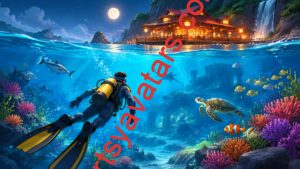 Some games give you one big idea and build everything around it. Dave the Diver takes a different approach: it keeps changing the rhythm just when you think you have settled into a routine. One moment you are swimming through a mysterious underwater environment, collecting resources and watching your oxygen supply. Later, you are helping operate a restaurant, improving equipment, meeting unusual characters, and preparing for another trip beneath the surface.
Developed and published by MINTROCKET, Dave the Diver received its full PC release on June 28, 2023. Its official description presents it as a single-player adventure/RPG and management hybrid built around daytime ocean exploration and nighttime restaurant management.
That combination sounds unusual—and that is exactly why it works. 🎮
🤿 A Gameplay Loop That Constantly Gives You Something to Do
The basic rhythm is simple: dive, gather, return, manage, upgrade, repeat. But each part feeds naturally into the next.
During underwater expeditions, you explore the ever-changing Blue Hole, catch or collect marine life, search for useful materials, and keep an eye on your limited oxygen. The resources you bring back can help support the restaurant side of the game, while the money earned there can be invested in better equipment for future dives. Steam’s official game description specifically highlights equipment upgrades, resource gathering, restaurant profits, and the risk of losing collected items when oxygen runs out.
That creates one of gaming’s most satisfying feelings: almost everything you do contributes to your next goal. 💰➡️🤿➡️🍽️➡️💰
🌊 Exploration Feels Relaxed—Until It Suddenly Doesn’t
The underwater sections can feel peaceful at first. You descend through blue water, weave between rocks and plants, observe marine life, and decide what is worth collecting.
But the deeper you travel, the more important preparation becomes. Oxygen is not just a decorative meter; it limits how long you can remain underwater. Equipment choices also matter because the official game description emphasizes upgrading and forging gear to deal with threats found during exploration.
This creates a pleasant tension. Do you return safely with what you already collected, or push deeper because you spotted something interesting?
That small decision appears again and again, making even ordinary dives feel like miniature adventures.
🍣 Then the Game Changes Completely
After exploring the ocean, Dave the Diver switches its focus to restaurant management. The contrast is a major part of the game’s identity: MINTROCKET describes the game as an ocean-adventure and tycoon hybrid, while Steam calls out the daytime-diving and nighttime-restaurant structure directly.
Instead of watching oxygen and searching the seafloor, you start thinking about ingredients, customers, menu choices, efficiency, and income.
And because the two halves are connected, the management sections do not feel like a completely separate mini-game. What happens underwater affects what becomes possible above water.
That connection is the secret sauce. 🍱
⚙️ Progression Makes “One More Dive” Very Tempting
Progression-heavy games are at their best when upgrades change what the player can attempt rather than simply making numbers larger.
Dave the Diver uses resources and restaurant earnings to improve equipment, which lets players prepare for more demanding expeditions. The official Steam description specifically notes upgrading and forging equipment using collected resources and restaurant profits.
This means a successful evening can make tomorrow’s dive more ambitious. A productive dive can improve the next restaurant service. Each system pushes the other forward.
That is why stopping after “just one more dive” can become surprisingly difficult. 😄
🐠 Variety Keeps the Ocean Interesting
MINTROCKET and Steam both emphasize the game’s underwater discovery. Steam describes a hybrid visual presentation combining pixel and 3D graphics and says the marine environment contains more than 200 kinds of sea creatures.
For players, that variety matters because exploration works best when the next screen can still surprise you. New creatures, resources, hazards, objectives, and environmental changes keep the act of diving from becoming purely mechanical.
Instead of simply traveling from Point A to Point B, you are constantly scanning the environment and asking:
- 🐟 What is that creature?
- 💎 Is that resource worth carrying?
- 🫧 Do I have enough oxygen to go deeper?
- ⚠️ Is the reward worth the risk?
- 🎒 Should I return now or keep exploring?
Those decisions give the ocean a sense of possibility.
😂 Humor Helps Balance the Management and Adventure
Dave the Diver is not presented as a grim survival simulation. Its official Steam description highlights eccentric characters, humorous scenes, spoofs, and a lighthearted narrative.
That lighter tone is important because the game asks players to juggle many different systems. Humor gives the experience breathing room and makes the shift between exploration, story moments, upgrades, and restaurant work feel playful rather than exhausting.
It is a game that can create tension without taking itself too seriously.
🎨 The Visual Mix Gives It a Distinct Personality
Steam describes the game’s presentation as a combination of pixel and 3D graphics.
For players who enjoy expressive game art, that mixture helps separate Dave the Diver from both realistic diving games and traditional management simulators. The underwater world can feel atmospheric while characters and interface elements retain a playful game-like quality.
For an art-focused gaming community such as ArtsyAvatars.com, it is also a good reminder that memorable visual identity does not require photorealism. Strong silhouettes, readable themes, expressive environments, and consistent art direction can be more important than raw graphical complexity.
🧑🎨 Avatar Inspiration Without Copying the Game
If Dave the Diver inspires you to create your own gaming avatar, the safest creative direction is to borrow broad themes rather than protected character designs.
For example, you could create an original ocean explorer with:
- 🤿 Generic diving equipment with your own shapes and colors
- 🐚 Seashell, coral, bubble, or wave motifs
- 🔦 An original underwater exploration tool
- 🐠 Completely original fish and marine companions
- 🌌 A deep-ocean background with dramatic light rays
- 🍽️ A subtle restaurant or culinary theme
Avoid copying Dave’s exact appearance, costume, face, logo treatment, UI, promotional compositions, or other recognizable game artwork. The goal is to capture the idea of ocean exploration and food-service adventure while designing something that is unmistakably your own.
🎯 Who Is Dave the Diver Best For?
You may especially enjoy Dave the Diver if you like games that mix several genres instead of staying inside one strict formula.
Its official classifications on Steam include Adventure, Casual, RPG, and Simulation, while its core description emphasizes exploration, fishing, resource gathering, equipment progression, and restaurant management.
It can therefore appeal to players who enjoy:
- 🌊 Exploration and discovery
- 🐟 Fishing and resource collection
- 🍣 Management and optimization
- ⚙️ Equipment upgrades
- 📖 Lighthearted story moments
- 🎮 Single-player progression
- 🧩 Games with multiple interconnected systems
💡 Beginner Mindset: Don’t Rush Every Dive
A useful way to approach the game is to treat each dive as a small expedition rather than trying to collect absolutely everything.
Because oxygen limits how long you can remain underwater and running out can cost collected items, choosing when to return is part of the risk-reward structure.
Explore carefully, learn what resources are useful, improve your equipment, and let your restaurant progress support your next expedition. The systems are designed to feed one another, so steady progress can be more rewarding than reckless dives.
🏆 What Makes Dave the Diver Stand Out?
Its greatest strength is not any single mechanic. It is the way different mechanics connect.
Exploration gives you resources. Resources support restaurant operations. Restaurant income supports upgrades. Upgrades encourage deeper exploration. Story and humor appear between those systems so the experience rarely feels stuck in one mode for too long.
That structure is why Dave the Diver can feel relaxing, strategic, funny, and adventurous within the same play session.
🌟 Final Thoughts
Dave the Diver is a strong example of what happens when developers combine familiar ideas in an unexpected way. Diving, fishing, resource gathering, upgrades, restaurant management, story scenes, and humor could easily feel disconnected, but the game’s central loop ties them together.
If you enjoy games where every session gives you another small objective to chase, another upgrade to unlock, or another mystery to explore, this ocean adventure is easy to understand—and very easy to keep playing.
🎨 Want more gaming inspiration, avatar ideas, and game-focused features? Keep exploring ArtsyAvatars.com for more creative gaming content.
Editorial note: Dave the Diver and related game names are referenced only to identify the game discussed. ArtsyAvatars.com is not presented here as affiliated with or endorsed by MINTROCKET. This article uses original commentary and does not reproduce game screenshots, logos, dialogue, or promotional artwork.