


Kingdom Come Deliverance II — When a Medieval World Actually Remembers What You Do ⚔️🏰
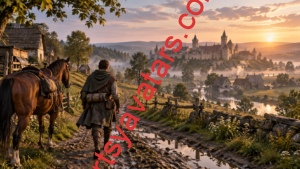 Some RPGs make you feel like the center of the universe.
Kingdom Come: Deliverance II aims for something more interesting: making you feel like one person trying to survive inside a world that was already moving before you arrived.
Rather than turning medieval Europe into a colorful fantasy playground filled with magical shortcuts, the game leans heavily into grounded role-playing, historical atmosphere, difficult decisions, social consequences, exploration, and the small details that can make a virtual world feel believable.
That is exactly why it stands out for players who enjoy slow-burn adventures, meaningful choices, immersive simulation, and RPG systems that reward patience. 🛡️
🏰 A Medieval World That Feels Lived In
One of the biggest attractions of Kingdom Come: Deliverance II is not simply its castles, forests, villages, roads, or taverns. It is the feeling that these locations belong to an actual society.
You are not just running between quest markers.
You are moving through settlements where status matters, clothing matters, reputation matters, and the way you behave around people can shape how they react to you.
That changes the rhythm of exploration.
A muddy road through the countryside can feel as important as a heavily fortified town because danger, opportunity, conversation, and unexpected encounters may exist anywhere.
For players who love becoming absorbed in a setting rather than simply completing objectives, this kind of design can make every journey feel like part of the adventure.
⚔️ Combat Feels Like a Skill, Not Just a Button
Many action games want you to feel powerful immediately.
This type of medieval RPG takes a different approach.
Fighting is something that demands observation, timing, positioning, equipment awareness, and patience. Charging into every confrontation without thinking can quickly turn an apparently simple fight into a disaster.
That makes victories more satisfying.
Instead of defeating opponents because your character has reached a sufficiently high number, combat can feel like something you gradually learn.
You begin to understand when to attack, when to defend, when to create distance, and perhaps most importantly—when fighting is a terrible idea. 😅
That last lesson is important because a believable RPG world becomes much more exciting when violence is only one possible solution.
🗣️ Sometimes Your Best Weapon Is a Conversation
Great role-playing is not only about swords.
It is also about deciding what kind of person you want to become.
Do you try to persuade someone?
Do you intimidate them?
Do you take the honorable route?
Do you manipulate the situation for personal advantage?
Or do you simply walk away?
When an RPG gives social choices genuine importance, conversations stop feeling like pauses between battles. They become part of the gameplay itself.
This is especially appealing for players who enjoy building a character through behavior rather than merely selecting statistics from a menu.
🎭 The Best RPG Stories Are the Ones You Help Create
A memorable role-playing game usually has two stories happening at once.
The first is the story written by the developers.
The second is the story created by the player.
Maybe you intended to handle a problem diplomatically but accidentally offended someone.
Maybe you prepared carefully for a dangerous encounter and everything went perfectly.
Maybe you got lost, wandered away from your original goal, and discovered something far more interesting.
Those unscripted moments often become the stories players remember years later.
That is where immersive RPGs shine. They give players enough structure to create tension but enough freedom for unexpected situations to happen naturally.
🌲 Exploration Works Better When the Journey Matters
Modern open-world games sometimes overwhelm players with icons.
Every hill becomes a checklist.
Every building becomes an objective.
Every road becomes something you rush through while following a marker.
A slower medieval RPG encourages a different mindset.
Look at the landscape.
Notice the road.
Think about where you are going.
Prepare before leaving safety.
Pay attention to what happens between destinations.
That might sound simple, but it can completely change how an open world feels.
When travel contains uncertainty, reaching a destination can become an accomplishment rather than a loading screen with extra steps.
🧩 Consequences Make Choices More Interesting
A choice is only meaningful when something can happen because of it.
That does not necessarily mean every decision needs to change the entire story.
Smaller consequences can be even more immersive.
Your reputation might change.
A conversation may become easier or harder.
Someone may remember how you behaved.
A situation may develop differently because you arrived prepared—or completely unprepared.
These systems help create the illusion that the world is paying attention.
And once players believe the world is paying attention, they start paying more attention too.
🛡️ Preparation Becomes Part of the Adventure
There is something strangely satisfying about preparing for a journey in an RPG.
Checking equipment.
Making sure you have what you need.
Thinking about where you are heading.
Considering whether your current clothing or gear suits the situation.
Deciding whether you are ready for a dangerous route.
Games built around these details turn preparation into gameplay rather than inventory management.
It can also create great tension because mistakes feel personal.
If you rush into trouble without preparation, the game does not need to tell you that you made a bad decision.
You will probably discover that yourself. 😬
🐎 Why Slow-Burn RPG Fans May Love It
Kingdom Come: Deliverance II is particularly attractive to players who enjoy immersion more than instant gratification.
If your favorite RPG moments involve wandering through believable environments, learning complicated systems, talking your way through problems, developing skills gradually, and seeing how the world reacts to your decisions, there is a lot to appreciate in this style of game.
It is less about becoming an unstoppable fantasy hero within the first hour.
It is more about becoming capable through experience.
That progression can feel far more personal.
🔥 Who Is This Kind of Game Best For?
You may especially enjoy Kingdom Come: Deliverance II if you love:
- ⚔️ Grounded medieval combat
- 🏰 Historically inspired worlds
- 🗣️ Dialogue and social role-playing
- 🌲 Open-world exploration
- 🎭 Choices with consequences
- 🛡️ Equipment and preparation systems
- 🐎 Slow, immersive adventures
- 📜 Story-rich single-player RPGs
- 🧠 Games that reward patience and observation
Players looking primarily for nonstop arcade-style action may need time to adjust to its deliberate pace.
But for the right player, that deliberate pace is exactly the attraction.
🎮 Why Kingdom Come: Deliverance II Feels Different
The most interesting thing about Kingdom Come: Deliverance II is not that it lets you visit a medieval world.
Plenty of games can do that.
The difference is the attempt to make you live according to the rules of that world.
Your actions matter.
Your preparation matters.
Your decisions matter.
Your mistakes matter.
And sometimes the most memorable adventure is not the heroic victory you planned—it is the ridiculous disaster you somehow survived. 😂⚔️
🏁 Final Thoughts
For gamers tired of open worlds that feel like enormous checklists, Kingdom Come: Deliverance II offers a different fantasy: not limitless power, but believable participation.
You enter a dangerous medieval society, learn how it works, discover what kind of character you want to become, and slowly earn your place inside it.
That combination of exploration, role-playing, consequence, realism, and unpredictable player-created stories is what makes this kind of RPG so compelling.
Would you play as an honorable swordsman, a silver-tongued negotiator, a wandering troublemaker—or somehow all three? ⚔️😄
Keep exploring ArtsyAvatars.com for more gaming features, RPG discussions, creative gaming culture, and original gamer-focused content. 🎮✨