


Kingdom Come: Deliverance — Why This Medieval RPG Still Rewards Patience ⚔️🏰
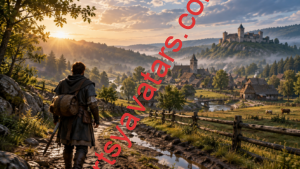 Some role-playing games make you feel powerful within minutes. Kingdom Come: Deliverance takes almost the opposite approach. It asks you to enter a dangerous medieval world as an inexperienced person, learn how that world works, improve through effort, and gradually become more capable.
Released on February 13, 2018, Kingdom Come: Deliverance is a story-driven, single-player open-world RPG developed by Warhorse Studios. Its setting is medieval Bohemia within the Holy Roman Empire, with players exploring forests, villages, castles, roads, and settlements while becoming involved in a larger conflict.
That grounded approach gives the game an identity that feels very different from fantasy adventures filled with supernatural powers, monsters, or magical equipment. 🛡️
Kingdom Come: Deliverance Makes Being Inexperienced Part of the Adventure 🎯
One of the most interesting ideas behind the game is that your character does not begin as an unstoppable warrior. The early experience can feel awkward, dangerous, and even humbling.
That is part of the appeal.
Instead of treating weakness as something to skip past, the game turns improvement into a major part of the role-playing experience. Learning how to survive difficult encounters, choosing when to fight, preparing before traveling, and gradually becoming more confident can make progress feel earned rather than automatic.
For players who enjoy games where personal improvement matters as much as collecting equipment, this approach can be extremely satisfying. 🧠⚔️
A Medieval World That Tries to Feel Like a Place, Not a Theme Park 🌲
The official game description emphasizes exploration across realistic medieval environments including castles, forests, and villages in Bohemia.
What makes that concept interesting is the atmosphere it creates. A muddy road through the countryside can feel like part of the adventure. A distant settlement can become a destination rather than simply another icon on a map. Entering a town after traveling through dangerous territory can produce a sense of relief that highly accelerated open-world games sometimes lose.
The environment also supports a slower style of exploration. Instead of constantly chasing visual effects or enormous fantasy landmarks, the appeal comes from ordinary medieval spaces: farms, roads, woodland, stone buildings, taverns, fortifications, and rural communities.
That grounded scenery can make even simple journeys feel surprisingly memorable. 🌄
Combat Feels More Dangerous When You Are Not a Superhero ⚔️
Kingdom Come: Deliverance is officially categorized on Steam as an action, adventure, and RPG title, with player tags emphasizing medieval combat, realism, swordplay, historical themes, and open-world exploration.
From a player-experience perspective, the important difference is that combat rarely feels like a consequence-free power fantasy.
Rushing into every confrontation can be a bad habit. Reading the situation, choosing your battles, improving your skills, and approaching danger carefully often feels more appropriate to the world the game is trying to create.
This changes the emotional rhythm of encounters. Winning is satisfying not simply because an enemy disappears, but because the situation may have looked genuinely threatening a few moments earlier.
For players accustomed to fast action games, the adjustment can take time. For players who enjoy methodical systems and gradual mastery, that learning curve can become one of the game’s biggest attractions. 🛡️
Role-Playing Through Choices Instead of Just Statistics 🧭
The Steam description specifically highlights quests and player choices as important parts of the experience.
That fits naturally with the game’s grounded identity. Role-playing is not only about increasing numbers on a character sheet. It is also about deciding how you approach situations.
Do you prepare carefully or improvise? Do you avoid trouble or confront it? Do you explore another road before continuing the main objective? Do you spend time improving your abilities before taking on something difficult?
These smaller decisions help create personal stories.
Two players can remember the same quest differently because one remembers the objective while another remembers getting lost, arriving unprepared, escaping a dangerous encounter, finding an unexpected route, or barely reaching safety.
That is where open-world role-playing becomes more than simply completing markers. 🎮
The Slow Pace Is a Strength — But Not for Everyone ⏳
This is also where expectations matter.
If you want instant power, nonstop combat, fantasy spectacle, or effortless progression, the deliberate pace may feel demanding.
But if you enjoy learning systems, gradually developing a character, exploring believable environments, and treating preparation as part of the adventure, the slower pace becomes much easier to appreciate.
The game often works best when you stop trying to rush it.
Walk through the countryside. Explore side roads. Pay attention to your surroundings. Spend time learning. Allow mistakes to become part of your story.
That mindset can transform frustration into immersion.
Why Kingdom Come: Deliverance Still Appeals to RPG Fans 🏹
Years after its 2018 release, the original game remains available on Steam, where it is still presented as a story-rich medieval open-world RPG centered on exploration, quests, choices, and realistic historical environments.
Its lasting appeal comes from a simple idea: becoming capable is more interesting when capability has to be earned.
The game does not need dragons flying over every mountain or magical weapons glowing in every dungeon. Its drama can come from being far from safety, entering an unfamiliar settlement, preparing for a dangerous journey, or realizing that a fight you started may have been a terrible idea.
Those moments create tension through vulnerability rather than spectacle.
Who Should Try Kingdom Come: Deliverance? 🎮
This game may be worth exploring if you enjoy historical settings, slow-burn character progression, open-world exploration, difficult learning curves, grounded role-playing, and games where preparation matters.
Players who mainly prefer fast arcade combat or immediate power progression may find its deliberate approach less appealing. That is not necessarily a weakness; it simply reflects the type of experience the game is designed to provide.
Final Thoughts: A Medieval Journey Built Around Growth 🏰
Kingdom Come: Deliverance stands out because it is willing to let the player begin inexperienced.
Instead of immediately telling you that you are a legendary hero, it gives you room to become better through experience. The forests feel more dangerous because you are vulnerable. Victories feel more meaningful because failure is possible. Exploration feels more personal because the world is not constantly trying to turn every moment into spectacle.
For RPG fans who enjoy patience, immersion, exploration, and gradual mastery, this medieval adventure offers a distinctive journey worth experiencing.
⚔️ What kind of RPG player are you? Do you prefer becoming powerful immediately, or do you enjoy games where every new skill feels earned?
Share your thoughts with the gaming community at ArtsyAvatars.com. 🎨🎮
Editorial/IP note: This is independent commentary created for ArtsyAvatars.com. The game title is referenced only to identify the subject being discussed. This article does not reproduce official screenshots, logos, promotional artwork, UI assets, story text, or character artwork.