


⚔️ Sekiro: Shadows Die Twice – Why Its Sword Combat Still Stands Out
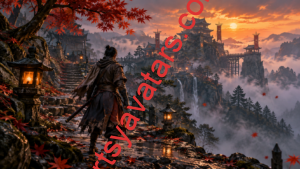 Sekiro: Shadows Die Twice is the kind of action-adventure game that can completely change how you think about sword combat. Instead of encouraging players to circle an enemy and wait for a safe opening, it pushes you directly into the clash. Steel meets steel, attacks are deflected at the last possible moment, pressure builds, and one mistake can suddenly turn a confident duel into a desperate fight for survival.
Developed by FromSoftware, the game combines aggressive swordplay, stealth, vertical movement, prosthetic tools, exploration, and a resurrection mechanic within a fictionalized world influenced by Japan’s Sengoku era. ⚔️🌸
If you enjoy games that reward practice rather than button-mashing, there is a lot to appreciate here.
🎮 What Makes Sekiro: Shadows Die Twice Different?
The biggest difference is simple: combat is built around confrontation.
Many action games teach you to avoid attacks first and punish enemies afterward. Sekiro frequently asks you to stand your ground. A well-timed deflection can damage an opponent’s posture, allowing you to break their defense and create a decisive opening.
That changes the rhythm of every duel.
You are not simply reducing a health bar. You are trying to control the tempo of the encounter.
Attack. Deflect. Pressure. React. Repeat.
When the rhythm finally clicks, difficult battles can start to feel almost like fast-moving sword choreography. 🗡️
🛡️ The Posture System Turns Defense Into Offense
One of Sekiro: Shadows Die Twice‘s defining ideas is its posture system.
Blocking may keep you alive temporarily, but accurate deflections are far more powerful. Successful defensive timing can actively push an enemy closer to losing control of the duel.
This creates a fascinating risk-versus-reward loop:
- ⚔️ Keep attacking to maintain pressure.
- 🛡️ Deflect incoming strikes instead of constantly retreating.
- 👀 Read enemy animations carefully.
- 🔥 Stay composed when the pace suddenly increases.
- 💥 Exploit the opening when your opponent’s defense finally breaks.
The result is combat that rewards observation and muscle memory more than raw aggression.
🥷 Stealth Gives You Another Way to Approach Danger
Not every encounter needs to begin with two swords colliding.
Stealth allows you to scout areas, move around groups of enemies, find advantageous routes, and sometimes remove a threat before a larger battle begins.
This matters because difficult encounters are often easier when you understand the environment first.
A player rushing directly through the front gate may face several enemies at once. A patient player might discover rooftops, ledges, vegetation, side paths, or elevated positions that create a much safer approach.
That mixture of stealth and direct combat helps exploration feel connected to survival rather than simply being a way to travel between fights.
🪝 Vertical Movement Changes Exploration
The grappling-based traversal system gives the world a strong sense of verticality.
Instead of viewing a fortress wall or rooftop as background scenery, you begin wondering whether it can become a route.
That makes exploration more active. High ground can reveal hidden paths, alternate entrances, enemies, items, and new perspectives on an area.
It also gives battles another dimension. Sometimes escaping upward, repositioning, or entering from an unexpected angle can be more useful than charging forward.
🧰 Prosthetic Tools Reward Experimentation
Sword technique remains central, but different prosthetic tools provide tactical options for specific situations.
The important lesson is not to treat every enemy identically.
If a battle feels impossible, the answer may not be faster reactions. It could be a different tool, positioning choice, combat technique, or approach to the encounter.
That encourages experimentation—a quality that makes repeated attempts feel less like simple repetition and more like problem-solving. 🧠
💀 Failure Becomes Part of Learning
Yes, Sekiro can be demanding.
But difficulty is only part of the experience.
A tough enemy often exposes a specific weakness in the way you are playing. Perhaps you are dodging when you should deflect. Maybe you are attacking too many times before defending. Maybe panic is causing you to react early.
Each attempt can provide information:
- What attack pattern caught you?
- Which animation signals the next move?
- When can you safely attack?
- When should you stop attacking?
- Can movement or a tool change the encounter?
That is why finally overcoming a difficult fight can feel so satisfying. The player’s improvement becomes part of the progression.
🔥 Boss Battles Test More Than Reflexes
Boss encounters are among the moments where the game’s systems come together most clearly.
Reaction speed helps, but recognizing patterns, maintaining pressure, understanding distance, and staying calm are just as important.
Some battles may initially appear overwhelming. Then, after several attempts, individual attacks become recognizable. What once looked chaotic begins to have structure.
That transformation—from confusion to control—is one of the strongest feelings the game can produce.
🌄 A World That Rewards Curiosity
The environments are not merely arenas for combat.
Exploration can lead to alternate routes, useful items, optional encounters, environmental storytelling, and places that are easy to overlook if you always follow the most obvious path.
The mix of temples, fortifications, forests, cliffs, villages, caves, and supernatural spaces gives the journey visual variety while reinforcing its dark historical-fantasy atmosphere.
For players who enjoy searching every corner of a game world, there is plenty of reason to slow down and look around.
🎯 Beginner Mindset: Don’t Play Every Fight Like a Traditional Action RPG
A useful early lesson is to resist the urge to constantly retreat.
Sekiro often becomes more manageable when you learn to remain close enough to control the fight.
Try focusing on a few fundamentals:
- ✅ Learn the timing of ordinary enemy attacks.
- ✅ Practice deflection instead of depending entirely on blocking.
- ✅ Avoid frantic button presses.
- ✅ Watch the opponent rather than your own character.
- ✅ Use stealth when an area contains multiple threats.
- ✅ Experiment when your usual strategy stops working.
- ✅ Treat defeat as information rather than lost progress.
Most importantly, do not expect every technique to become comfortable immediately.
🏆 Why Sekiro: Shadows Die Twice Remains Memorable
What makes Sekiro: Shadows Die Twice memorable is not simply that it is difficult. Plenty of games can make enemies stronger or mistakes more punishing.
Its identity comes from the way its mechanics support one another.
Traversal encourages exploration. Stealth rewards planning. Prosthetic tools encourage experimentation. The posture system rewards controlled aggression. Deflection turns defense into pressure. Resurrection can create another opportunity after a mistake.
Together, those systems produce a style of action that feels focused and distinctive.
🎮 Who Might Enjoy It?
Sekiro may appeal to you if you enjoy:
- ⚔️ Precise melee combat
- 🧠 Learning enemy patterns
- 🥷 Stealth mixed with direct action
- 🪝 Vertical exploration
- 👹 Challenging boss encounters
- 🌸 Dark historical-fantasy environments
- 🏆 Games where personal improvement matters
Players looking mainly for relaxed combat or extensive character-build customization may find its focused approach less forgiving. But for players who enjoy mastering a tightly designed combat system, that focus is exactly what makes the experience compelling.
✨ Final Thoughts
Sekiro: Shadows Die Twice demonstrates how exciting a combat system can become when attacking and defending are part of the same rhythm.
Its most rewarding moments often arrive after failure: the attack you finally learn to read, the deflection you stop missing, the route you did not notice before, or the boss that suddenly feels manageable after appearing impossible.
That constant transition from struggle to understanding is at the heart of the adventure. ⚔️🔥
What was the moment when Sekiro’s combat finally “clicked” for you? Share your experience with the ArtsyAvatars gaming community.
Editorial/IP notice: Sekiro: Shadows Die Twice is referenced for commentary and discussion. Game names and related trademarks belong to their respective owners. ArtsyAvatars is not affiliated with, endorsed by, or sponsored by FromSoftware or Activision. The accompanying ArtsyAvatars artwork is an original, non-official illustration and does not reproduce game screenshots, logos, or character artwork.