


DOOM (2016): Why This Fast-Paced FPS Still Hits Hard 🔥
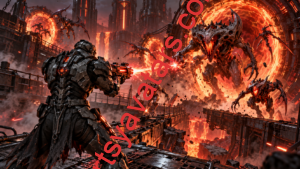 Some shooters encourage you to hide behind cover, carefully conserve ammunition, and wait for the perfect opportunity to attack. DOOM (2016) has a very different idea: keep moving, keep fighting, and turn every combat encounter into controlled chaos. 🎮🔥
Developed by id Software and published by Bethesda Softworks, DOOM arrived in May 2016 as a modern return for the long-running first-person-shooter series. Bethesda described the campaign around fast movement, aggressive gunplay, upgrades, melee finishing attacks, and relentless encounters rather than cover-based combat.
Years later, that basic philosophy remains one of the biggest reasons the game is so enjoyable. Instead of simply recreating an older style of shooter, it combines classic speed with modern presentation and progression.
🔥 What Is DOOM (2016)?
DOOM (2016) is a first-person action shooter centered on a research facility on Mars that has been overwhelmed by demonic forces. The player takes control of a heavily armed marine and fights through the facility and other hostile environments while attempting to stop the invasion.
That premise is deliberately straightforward. The campaign spends much more of its energy on movement and combat than lengthy conversations or complicated storytelling.
And that works perfectly for the experience it wants to deliver. 🚀
⚡ DOOM (2016) Combat Is Built Around Movement
The biggest attraction of DOOM (2016) gameplay is its momentum.
Bethesda specifically promoted the campaign as one without traditional cover-based play or automatic health regeneration. Instead, the player is encouraged to combine movement, firearms, upgrades, and close-range finishing attacks while staying active during encounters.
That changes how you think during a battle.
You are constantly asking:
- 🎯 Which enemy should I target first?
- 🏃 Where can I move next?
- 💥 Which weapon fits this situation?
- ❤️ Do I need health?
- 🔫 Do I need ammunition?
- ⚠️ What enemy is controlling the arena?
Standing still usually feels like the wrong answer.
The result is an FPS where successful combat can start to feel almost rhythmic. You move, attack, reposition, change weapons, finish an enemy, and immediately identify your next target.
🔫 Weapons Encourage Constant Experimentation
A fast shooter would lose much of its appeal if every encounter could be solved with the same weapon.
DOOM avoids that problem by giving players an arsenal suited to different combat situations. The official game description highlights its futuristic weaponry as one of the foundations of the combat system.
The enjoyable part is not simply obtaining stronger equipment. It is learning when to switch between different tools while enemies are surrounding you.
One encounter might reward distance and precision. Another might push you into aggressive close-range fighting. Larger enemies can force you to rethink your positioning entirely.
Weapon switching therefore becomes part of the movement system rather than something you only do between battles.
👹 Enemies Turn Arenas Into Combat Puzzles
One reason the battles remain exciting is that enemy pressure frequently comes from several directions.
Rather than treating every creature as another target standing directly in front of you, the game creates situations where movement routes and target priority matter.
A dangerous enemy at long range may deserve attention first. A smaller creature nearby might become useful for recovering resources. Meanwhile, another opponent may force you out of the position you were planning to use.
That creates a simple but effective combat loop:
Observe → Move → Attack → Reposition → Adapt → Repeat. 🔄
When everything is working together, the arena becomes less like a traditional shooting gallery and more like a constantly changing action puzzle.
🏃 Why Speed Matters So Much in DOOM (2016)
Movement is not just transportation between enemies. It is one of your most important defensive tools.
The official campaign material emphasized fast, aggressive play instead of stopping behind cover.
That philosophy makes the player feel powerful without removing danger.
You can be heavily armed and still get overwhelmed if you lose awareness of the arena.
For players accustomed to slower military shooters, the adjustment can initially feel unusual. Once the movement starts to click, however, battles become much more satisfying.
🗺️ Exploration Rewards Curious Players
DOOM may be famous for combat, but rushing directly toward every objective means missing part of the experience.
The campaign encourages players to investigate its environments for secrets and upgrades, adding another layer between its major encounters. Bethesda itself highlighted players searching for secrets as part of the launch experience.
This creates a welcome contrast.
One moment you are moving at full speed through an intense battle. A few minutes later, you might be examining an overlooked corridor or trying to determine how to reach a hidden area.
That change of pace prevents the campaign from becoming nonstop visual noise.
🧠 Progression Gives You Reasons to Experiment
Although the combat has an old-school attitude, DOOM (2016) also includes modern progression systems.
Bethesda’s campaign description specifically identifies upgrades as part of the game’s combat toolkit.
Progression works particularly well because it gives players opportunities to shape how they approach encounters rather than completely replacing the underlying shooting mechanics.
The fundamentals remain important from beginning to end:
- Keep moving.
- Understand the arena.
- Control dangerous enemies.
- Use the right tool at the right moment.
- Stay aware of your resources.
Upgrades expand those possibilities instead of doing all the work for you.
🎵 Presentation Makes Every Encounter Feel Bigger
DOOM’s visual and audio presentation is designed around intensity.
The game runs on id Tech 6, which Bethesda identified as the technology powering the 2016 release. The company highlighted features including dynamic lighting while discussing the engine before launch.
Industrial environments, dramatic lighting, rapid movement, explosive effects, and aggressive audio combine to reinforce the pace of combat.
The important part is how all of these elements support gameplay rather than merely decorating it.
When a battle escalates, the game communicates that intensity immediately.
🛠️ DOOM SnapMap Added Another Side to the Game
DOOM (2016) was not limited to its campaign.
It also launched with multiplayer and SnapMap, an in-game creation system that allowed players to build, customize, play, and share gameplay experiences and maps. Steam’s official listing continues to describe SnapMap as part of the game.
For players who enjoy experimenting with game mechanics and level ideas, SnapMap represents a very different experience from simply completing the campaign.
🎮 Why DOOM (2016) Still Feels Refreshing
Many games become memorable because of enormous worlds, complicated narratives, or hundreds of hours of content.
DOOM (2016) succeeds for a simpler reason:
It understands exactly what kind of game it wants to be.
Its strongest moments come from the interaction between movement, enemy pressure, arena layouts, resource management, and weapon selection.
There is remarkably little hesitation built into that formula.
Enter an arena.
Read the situation.
Move.
Fight.
Adapt.
Survive.
Then do it again somewhere even more dangerous. 🔥
👾 Who Should Try DOOM (2016)?
DOOM (2016) is especially worth exploring if you enjoy:
- ⚡ Fast-paced FPS combat
- 🔫 Constant weapon switching
- 🏃 Movement-focused gameplay
- 🗺️ Hidden areas and secrets
- 🎯 Skill-based arena encounters
- 👹 Sci-fi horror environments
- 🧠 Combat that rewards quick decisions
- 🔁 Replayable action-focused campaigns
Players who primarily want slow tactical combat or a dialogue-heavy role-playing experience may find that DOOM prioritizes very different things.
⚠️ Mature Content
DOOM is rated M for Mature 17+ by the ESRB for Blood and Gore, Intense Violence, and Strong Language.
That rating is worth keeping in mind before deciding whether the game is appropriate for a particular player.
🔥 Final Thoughts: Is DOOM (2016) Still Worth Experiencing?
DOOM (2016) demonstrates how effective a game can be when nearly every mechanic supports the same central idea.
Its movement encourages aggression. Its arenas encourage awareness. Its weapons encourage experimentation. Its enemies encourage adaptation.
Put those elements together and you get an FPS that rarely wants you to simply stand still and exchange bullets.
Instead, it turns every major battle into a test of movement, timing, positioning, and decision-making. 🎮💥
If fast shooters are your thing, DOOM (2016) remains an interesting example of how classic FPS principles can be rebuilt around modern technology and progression systems.
🎨 Build Your Gaming Identity with Artsy Avatars
Great games are often remembered because they create a distinctive atmosphere, and your online gaming identity can have personality too.
Explore more gaming articles, creative avatar ideas, and gaming-inspired content at ArtsyAvatars.com.
🎮 Keep playing. Keep exploring. Keep creating.
Sources Used for Game Facts
Bethesda — DOOM Campaign Trailer and official DOOM materials.
Steam — official DOOM store listing, including developer, publisher, gameplay features, multiplayer and SnapMap information.
ESRB — official DOOM rating and content descriptors.